From O’Hanlon’s, Lives of the Irish Saints, Vol. 2, pps. 249ff., 20th January, Article VIII.
(Part I - Early Life)
St. Colga, or Colcho, Surnamed the Wise, Lector of Clonmacnoise, King's County. [Eighth Century.] Improvement in religious life and training depends much on the frequent presence of holy bishops and pastors, in the schools and religious institutes, under their immediate care. This ensures educational efficiency, and blesses the house of education, even when the faith of pupils is in no way perilled. His frequent presence impresses, not alone on youth, but even on their parents, the importance of that business in which they are engaged. To this, the purity and innocence of children are mainly to be attributed, while such religious teaching and example exercise beneficial influences during after life. (1) At the 20th of February, Colgan has illustrated such particulars as are known, regarding the present holy man.(2) These he has drawn from various sources. The Bollandists have simply a brief notice, in which they state, that only in the Irish fasti do they find him commemorated, as one of the saints.(3) In Irish,
we are told, the name is written Coelchu; and, by some writers, it is rendered into Cogius, Colcius, Colcus,(4) Colcanus, Colchonus and Colganus. By Colgan, the denomination is thought to be derived from the Irish word, coel, "thin," or "slender," and cu, "a grey-hound," or " a wolf."(5) More generally Coelchu or Colgchu is rendered Colgu or Colga.(6_ This holy man was born, as seems most probable, after the beginning of the eighth century. He seems, from the family name given him, to have been of the Ui Eathach Mumhan race.(7) Yet, his pedigree has not been more exactly traced, than we find it briefly noted, in our Martyrologies and Annals. In an age of learning and piety, St. Colga was most distinguished among the holy men of Ireland. He was probably educated at Clonmacnoise. It was with him St. Paul the Apostle came to converse, according to the legend, in a human form, and to
help him on in his road. St. Paul is said to have given him particular lights, and to have taken his satchel of books, at Moin tirean air,(8) while, it was he that pleaded for this saint, to preside over the great school of Cluain-mac-nois.(9) It is doubtful, if amidst the ruins and ancient remains of this once
celebrated place, any traces of that college can now be found.(10) It is stated, likewise, that a great theological question was here in controversy, among the theologians; and doctors of another place held an opinion, differing from that of our saint. Again, St. Paul is said to have appeared in person, to have
taken part with our saint, and to have spoken to this effect before the seniors assembled.(11) Soon afterwards, St. Colcho was elected to preside, as Rector of the great school, at Clonmacnoise; and he was recognised as the chief teacher there, while shining pre-eminently a lamp of learning and of sanctity.
Notes in O'Hanlon
(1) See “Ecclesiastical Meditations suitable for Priests on the Missions and Students in Diocesan Seminaries." by a Catholic Clergyman. On the Visitation of the Schools, sect. 2, pp. 130, 131.
(2) See "Acta Sanctorum Hiberniae," xx. Februarii. De S. Colcho, sive Colga, Sapiente, pp. 378 to 380.
(3) See "Acta Sanctorum," tomus iii., Februarii xx. Among the pretermitted saints, p. 169.
(4) Thus is he styled, in Albinus' Epistle.
(5) A secondary meaning is sought for the name in Colg, which signifies, "a sword," or metaphorically, "a fierce look," or "cruelty."
(6) See ''Acta Sanctorum Hiberniae," xx. Februarii, n. 2, p. 379.
(7) This was the tribe name of the O'Mahonys and O'Donoghoes, in South Minister. See Dr. O'Donovan's "Annals of the Four Masters," vol. ii., nn. (a, r), pp. 772, 775.
(8) This place does not seem to be identified.
(9) See Rev. Drs. Todd's and Reeves "Martyrology of Donegal," pp. 54, 554.
(10) The accompanying illustration, from a photograph, taken by Frederick II. Mares, and drawn on the wood by William K.
Wakeman, was engraved by Mrs. Millard.
(11) In a work, known as the "Book of Clonmacnoise,” and in other Manuscripts belonging to Colgan, the foregoing statements were contained while tracts attributed to Colga were also in his possession. See "Acta Sanctorum Hibernias," xx. Feb- l6 Then follow these words : " Sapientis cap. ii., hi., iv., and nn. 6, 9, pp. 378, 379.
Tuesday, 12 July 2016

Wednesday, 15 June 2016
Religious Houses of Ardagh
From Fr. Walsh's History of the Irish Hierarchy:

Ardagh in the barony to which it gives its name Canons Regular St. Mel was bishop of Ardagh. See diocese of.
Archdall almost invariably calls the friars of St. Augustine canons regular though no such order existed in Ireland until they were introduced by St. Malachy and Imar, they were then called canons of St. Augustine or secular canons as St. Augustine drew up no particular rule for men.
St. Melchuo said to be the brother of St. Mel succeeded as abbot and bishop. See diocese of.
AD 741 died the abbot Beochuil.
Franciscan friary not known when it was founded Reformed by friars of the strict observance in the year 1521
Wednesday, 11 May 2016
Saint Mel of Ardagh (O'Hanlon 3)
From Canon O'Hanlon's Lives of the Irish Saints for 6th February:

Article II. - Reputed Festival of St. Melcu or Moelchuo, Supposed be a Bishop of Ardagh.
If we are to credit some records, at this date should we add the festival of a St. Melchu or a St. Moelchuo, thought by many to have been the brother and the inseparable companion of St. Mel. The Martyrology of Salisbury commemorates, at this date, four brothers, St. Mel, St. Melchuo, St. Munis, who are called bishops, and St. Rioch, called an abbot. They are said to have been distinguished for sanctity, and for many miracles. On the date, contained in such entry, Colgan confesses himself induced to place the festival of those reputed brothers, at the 6th of February; although, he says it is possible, St. Melchuo may be identified with St. Mellan, whose festival was observed on the 28th of October, in the territory of Hibh Echach, in Ulster. Other writers have followed Colgan's arrangement; among these may be noted Bishop Challoner, and Rev. S. Baring-Gould. Ancient tracts have also distinguished St. Mel from St. Melchuo, a reputed brother. Ware and Colgan are said to have been led astray by these accounts, but they are corrected by Dr. Lanigan. Both Mel and Melchus are represented as having been left, in Southern Teffia, by St. Patrick, and as jointly ruling over the see of Ardagh. The day of their festivals is the same—a circumstance rather singular, and suspicious — being reputed brothers, as co-bishops, likewise, in one and the same see. Without sufficient authority, Ware and Harris place Melchuo after Mel, in the order of succession. These names and notices are applied, it is thought, to one and the same person; the real etymon, which was probably Melchu, having been contracted, and Latinized into Melus or Mel, signifying "honey." Hence a false distinction of persons may have arisen.
St. Melchu — it has been asserted — was an assistant to St. Mel, during his missionary labours and preaching. It is thought, too, that Melchu had been consecrated bishop, by his reputed uncle, St. Patrick; and that, he remained with his reputed brother Mel, in the monastery, at Ardagh. They are supposed to have been emulous of each other, only in sanctity, and that Maelchu, having thus persevered to the end, deserved to be registered among the saints. It is not probable, that Tirechan would have omitted to mention Melchu, in addition to Mel, had the former name belonged to a brother of Mel, and to a joint-administrator, at Ardagh. Nor is it likely, the name of Melchu should have been omitted, in our most authentic Irish Martyrologies and Annals, while particular mention is made of Mel or Melus. Labouring under a mistake, Colgan distinguishes St. Melchuo from St. Mel. He devotes a separate short notice to the former, after having given St. Mel's Acts in full, at the 6th of February. For his various illustrations and proofs, reference is made to these Acts.
Monday, 25 April 2016
Traditional Latin Mass in Longford Cathedral
For the 40th Anniversary of the death of Bishop James Joseph McNamee, who had been Bishop of Ardagh and Clonmacnoise from 1927 to his death on 24th April, 1966, our Association was granted the singular privilege by Bishop Francis Duffy, his successor as Bishop of Ardagh and Clonmacnoise of organising a Traditional Latin Mass in the newly refurbished Longford Cathedral celebrated by Bishop Colm O'Reilly, another of Bishop McNamee's successor's as Bishop of Ardagh and Clonmacnoise.
On Sunday, 24th April, 2016, members and friends of the Catholic Heritage Association gathered to pray for the soul of one of the most liturgically conscious of Ireland's Bishops of the mid-20th Century, who had attended the first three Sessions of the Second Vatican Council.


Tuesday, 12 April 2016
Clonebrone Abbey
From Fr. Walsh's History of the Irish Hierarchy:
Clonebrone in the barony of Granard between Granard and Edgeworthstown. The two Emerias are said to have been placed here in the time of St. Patrick and they are also said to have been the daughters of the unfortunate Milcho who refused to listen to the words of salvation from the lips of St. Patrick because the saint had been his captive. It is also said that at the time of receiving the veil they left the impression of their feet in the stone on which they stood.
AD 738 the virgin and abbess of Clonebrone St. Samthanna, daughter of Dyamranus, died. Her festival is celebrated on the 19th of December.
AD 771 died the abbess Sithmath.
AD 775 died the abbess Forblaith.
AD 778 this nunnery was destroyed by fire.
AD 780 died the abbess Elbrigh.
AD 791 died the abbess Lerveanvan.
AD 804 died the abbess Finbil.
AD 810 died the abbess Gormley, daughter of Flathnia.
AD 1107 died the abbess Cograch, daughter of Unon.
Monday, 14 March 2016
Saint Mel of Ardagh (O'Hanlon 2)
From Canon O'Hanlon's Lives of the Irish Saints for 6th February:


CHAPTER II.
ST. BRIGID'S INTIMACY WITH ST. MEL—ABSURD MISSTATEMENTS OF CERTAIN WRITERS NOTICED—ST. MEL A DISCIPLE OF ST. PATRICK—SAID TO HAVE WRITTEN THE IRISH APOSTLE'S ACTS—DEATH OF ST. MEL—HIS FESTIVAL—THE CATHEDRAL AND COLLEGE DEDICATED TO ST. MEL AT LONGFORD—CONCLUSION.
St. Brigid seems often to have visited St. Mel, when she resided not far from Ardagh. At one time, the king of that district entertained both these holy personages; and, a remarkable miracle was wrought by the illustrious abbess, at a banquet, given in their honour. The kindness of St. Mel, interceding with the king for a supposed transgressor, on this occasion, pleasingly illustrates the holy bishop's character. St. Mel and St. Moelchu — both being regarded as distinct — are stated to have accompanied the abbess, to a synod, which was held at Tailten, in Meath.
Our thoroughly ignorant and presumptuous antiquarian, Ledwich, confounds St. Mel, with a St. Maula, venerated in Kilkenny city, and said to have been the mother of St. Canice. He therefore, flippantly assumes, the sex of this present saint to be doubtful, and that other accounts about him are unauthentic. Perhaps, absurdity of statement is carried to a still further degree, where we find it gravely advanced, that St. Mel is to be identified with the Cuthite Melissa; and again, that he left his name to Mellifont. St. Mel is classed among the disciples of St. Patrick, by Colgan. There can be no doubt, that our holy bishop acted under the advice and direction of that great master. Whether or not, he survived St. Patrick is open to question. It seems probable enough, however, that Mel passed away from earth, before the Irish Apostle had terminated his earthly career.
It is said, that St. Mel wrote the Acts, virtues and miracles of his uncle, St. Patrick, while this latter holy man had been living; for, the great Apostle of Ireland is supposed to have survived our saint five years. For his death, a.d. 466 has been assigned. Mel departed this life, at Ardagh, however, about the year 487 or 488. St. AEngus the Culdee, the Martyrology of Tallagh, Marianus O'Gorman, Cathal Maguire, and the Martyrology of Salisbury, record this holy bishop's festival, at the present date. It was probably that of his death, which is usually assigned to the 6th of February, and according to accounts left by our Irish hagiographers. This corresponds with the 8th of the February Ides. In Ardagh diocese, his feast is a double of the first class, with an octave.
Notwithstanding the celebrity of this saint, Mel, Epis. —meaning bishop— is the only entry, in the Martyrology of Tallagh, concerning him. Besides this, we read, in the Martyrology of Donegal, as having a festival on this day, Mel, Bishop of Ard-achadh, in Tethbha. He was a disciple of Patrick, according to the same authority; but, nothing has been noted, about his relationship. Mel is regarded, as the first bishop over the see of Ardagh, and, he has been constantly venerated as the special patron saint of that diocese. Longford being of late years the chief town in the diocese of Ardagh, the magnificent new cathedral of St. Mel was commenced there, by the bishop of that see. Dr. O'Higgins, about forty years ago, and completed, nearly as it now stands, by the late bishop. Dr. Kilduff. The beautiful high altar was erected since this prelate's death, as a memorial to commemorate his zeal and virtues. The present bishop. Dr. Conroy, has contributed largely to complete the interior, and further improvements are yet contemplated. Adjoining the cathedral, a fine college has been erected, in a delightful situation, and on very extensive grounds, for purposes of lay and ecclesiastical education of a high order. This establishment has also been placed under the patronage of St. Mel. The fine cathedral, dedicated to St. Mel, at Longford, is one of the largest and handsomest ecclesiastical structures in Ireland. It is built of the finest grey marble limestone, which on the exterior is cut and carefully dressed, from the foundation to the projecting course, that crowns the walls. Cut stone mouldings enclose the windows exteriorly, and these are covered with moulded pediments. Six pillars are intended to support a grand pediment in front, but this portion has yet to be erected. The style throughout is of the Italian composite order. The ground plan includes a nave, connecting two side aisles, by a double range of eleven arches, divided on either hand, resting on twelve grey marble columns of great height, yet symmetrical and solid. The columns are capped by chiselled capitals, under the turning of the arches. A transept extends across the upper end of the nave and side aisles. A grand high altar of exquisitely white polished Carrara marble — of elaborate and congruent design with the style of building — is in the centre, and opposite to the great entrance by the nave. At the end of the right side aisle, there is a side altar of our Holy Redeemer, and at the end of the left side aisle, there is one dedicated to the Blessed Virgin. Transverse columns and arches are in the transepts. Four circular-headed windows light either side aisle, and they alternate with circular canopied niches, all with fine mouldings interiorly. Five such niches fill up the circular apse, behind the front altar. A circular-headed window, between similarly designed niches, ornaments either end of the transept. Twenty-eight angels, wrought in a highly artistic manner, rise immediately over the capitals of all the nave columns. The coved roof of the ceiling is wrought very tastefully in plaster, while a highly ornamental cornice runs over the whole circuit of nave and apse, in the same elaborate style. High in the coved ceiling, over the three large entrance vestibules, is the fine-toned organ of the choir. Two fine columns, with three connecting arches, support the organ-loft and choir. The vestibules, in front, lead to the nave and aisles. A moulded cornice runs immediately under the window sills, all through the cathedral. Twelve clerestory and circular-headed lights are over their respective colonnade arches, on either side of the nave. The bishop's throne is on the Gospel side, within the sanctuary; while the pulpit rises against the third circular column, on the Epistle side of the nave. Basso-relievo flat columns are placed along the walls of the transepts, of the side aisles, and of the apse. The campanile, surmounted with a dome, and terminated by an elaborate gilt cross, is an object of great architectural beauty. On an octagonal base, rising over the roof, are three projecting mouldings, each sustaining a highly ornate compartment of the campanile. Carved columns sustain the cornices.
As in the instance of the renowned Saint Mel, we find the holiest persons are not exempt from unjust suspicions. In like cases, we must have patience awhile; slanders are not usually long-lived. Truth is the child of Time; ere long she shall appear to rehabilitate the character of those, who respect her dictates. Then shall the caluminated and maligned retire from life, vindicated and rewarded. Even, should base calumny fasten a sting, a stigma, or a stain, on the motives or actions of departed persons; the Almighty, who knows the hearts of all men, and who views their whole course of conduct, in a clear light, will justify the innocent, and most certainly reverse the false opinions of all men, on the day of General Judgment.
Monday, 9 November 2015
Saint Mel of Ardagh (O'Hanlon 1)
From Canon O'Hanlon's Lives of the Irish Saints for 6th February:

Sixth Day of February
ARTICLE I.—ST. MEL, OR MELCHUO, BISHOP AND PATRON OF ARDAGH
DIOCESE.
[FIFTH CENTURY]
CHAPTER I. INTRODUCTION—PARENTAGE AND CONNEXIONS OF ST. MEL—HIS MISSION IN IRELAND AND CONSECRATION—BISHOP AND ABBOT AT ARDAGH—HIS PROPHECIES—VINDICATION OF ST. MEL'S AND OF ST. LUPITA'S CHARACTERS.
THE festival, commemorated by the Irish Church, on this day, recalls to our minds, that gratitude we owe to our early Christian missionaries, who helped to gather and labour, in the same field of noble enterprise with St. Patrick. Fervently and eloquently, St. Mel laid before the Irish Gentiles, that depth and richness of Divine love, which he declared had supremely distinguished Jesus Christ. He could not fail, in making a solid and lasting impression, on the minds of his hearers. These had never experienced any better consolations, and they dreamed of no brighter prospects, than what had been gleaned from the dark and unintelligible teaching and mysteries of Paganism. This holy man refuted errors, which prevailed in our island, while the shallow and empty professions of a Druidical priesthood were exposed to merited contempt, and in the course of a few generations they were consigned to utter extinction. This renowned saint is classed among the primitive fathers of our Irish Church. He was a contemporary, and, it has been asserted, a near relative to the great Apostle, St. Patrick. At the very dawn of Christianity in our island, an illustrious champion and preacher of the Gospel had been already prepared, for a strenuous encounter, with the spirit of darkness. He is named Mel or Melus, in old Latin acts; and, this title was typical of those honied stores of Divine wisdom and of saintly qualities, which had been hived within his breast. A special Life of this holy man is not known to exist. From various ancient Acts of St. Patrick, and of St. Brigid, as also from other sources, Colgan has compiled a Life of St. Mel, and he has admirably annotated it. In like manner, the Bollandists have inserted Acts of Saints Mel, Melchuo, Mune, and Rioc, Bishops, at the 6th day of February. From these authorities shall we chiefly draw succeeding materials, to render intelligible the recorded actions of the holy Bishop Mel, the special patron of Ardagh diocese. He seems to have been born, in the earHer part of the fifth century. It is said, Saint Mel or Melus was a nephew to the great Irish Apostle Patrick, and whose sister Darerca is named as Mel's mother. She was daughter to Calphurnius, if we are to credit ancient accounts, and her name, also, is found in the Calendars of our Saints. She was blessed, not alone through her personal virtues and merits, but even through her sainted progeny of children. These she brought up in the fear of God, and their lives were nobly devoted to His service. Her brothers and sisters were distinguished in a remarkable degree, likewise, for their services to religion. Whether by natural or supernatural descent, a race of holy persons derived origin, from these illustrious and saintly progenitors. According to a prevailing hypothesis, the two brothers of Darerca, and consequently the uncles to St. Mel, were St. Patrick, the great Apostle of Ireland, who is said to have been the director and spiritual father of over two hundred holy disciples, and Sannan, who was father to St. Patrick the Younger.
According to another account, Darerca had two sisters, whose names were Tygridia and Lupita. These were older, it is stated, than the mother of our saint. Tygridia is said to have had no less than seventeen sons and five daughters, all of whom devoted themselves to a religious life.'s Darerca is styled mother of the holy bishops, Mel, Moch, or Rioch, and Munis, the travelling companions, and co-labourers with their uncle St. Patrick. Yet, instead of two, as stated by Joceline, Colgan tells us, the greater probability is, that Darerca had four sisters; all of these being distinguished, either for their personal sanctity, or for the holiness of their offspring. There are grave and ancient authors, likewise, who tell us, that the large family of seventeen sons and two daughters belonged, not to Tygridia, but to Darerca, assumed to have been mother of our saint. Again, other hagiological writers say, that St. Patrick, the Irish Apostle, had five sisters, bearing respectively the names, Richella, Lupita, Tigrida, Liemania, and Darerca.
Some nominal variations, however, occur in their enumeration. The last named of these holy sisters is generally allowed to have been the parent of St. Mel. It is stated, that she had been married to Restitutus, a Lombard, and to Conis. Some authors state, she had sixteen other sons, besides Mel, and two daughters. All of these children were distinguished for their eminent sanctity. The father of our saint is called Conis, and he is supposed to have been a Briton. It is probable also, his son, the first bishop of Ardagh, had been a native of Britain. The particular place of his birth is not recorded. Colgan thinks, however, that Conis and Darerca were of Irish birth and descent, as the names themselves are Irish. Dr. Lanigan doubts, if Mel were at all a relation to St. Patrick. Maol is an equivocal word when applied to a man, it has the signification "bald" or "shaved," and when to an irrational animal, it signifies "without horns" or "ears." Thus, his real family origin is left very doubtful. Concerning St. Mel's early education, we have no reliable notices; however, it is related, he became a disciple to his reputed uncle, St. Patrick. He laboured with this illustrious Apostle, on the Irish mission. He taught many early converts of our island the principles of Christianity. Some are of opinion, St. Mel had been a bishop before he came to Ireland. He distinguished himself there so much, as a zealous preacher and as a holy missionary, that other writers assert, St. Patrick considered him worthy of being elevated to the episcopal dignity. It is said, St. Mel had been appointed to the see of Ardagh, when St. Patrick proceeded from Usneach towards that tract of country, now known as Longford. According to another supposition, however, St. Mel had not yet arrived in Ireland, at so early a period.3^ We are told, likewise, St. Mel had been elevated to the episcopal dignity, before the year 454. For, we read in the third chapter of St. Brigid's Life, attributed to St. Ultan of Ardbraccan, that Saints Mel and Melchuo, Bishops, came from Britain, at a time when the great Patroness of Ireland, St. Brigid, was borne in her mother's womb. Dr. Lanigan finds no reason for contradicting the statement, that Mel was bishop about the middle of the fifth century; but, he supposes, that the election of our saint to Ardagh see took place, when St. Patrick journeyed on his way, from Munster towards Ulster. It has been stated, that the great Apostle left his reputed nephew to reside near a high ridge, which bore the peculiar name, Bri Leith, now called Slieve Galree. It lies between Ardagh to the east, where St. Patrick left Bishop Mel, and Dmimchea, to the west, where his sister Lupita lived. This Sliabh Calraighe was so called from an ancient territory known as Calry or Calree, in Teffia, and within the present county of Longford. This mountain, so well defined in the district, was also called Sliabh Callann Bri Leith.
St. Mel built a famous monastery at Ardagh. At this place, also, it is recorded, he exercised the jurisdiction both of abbot and of bishop. Among other celestial endowments, our saint received the gift of prophecy, whereby he was enabled to predict future events. This was exemplified in St. Brigid's case, and soon after he had arrived in Ireland from Britain. He foretold the greatness and sanctity of that holy virgin, while yet carried in her mother's womb. Some time subsequent to St. Brigid's birth, St. Mel administered to her the Sacrament of Confirmation. In conjunction, probably, with his disciple St. Machaille, Mel likewise bestowed the religious veil on that youthful spouse of Christ. AfterAvards, the greatest friendship existed between our saint and the future abbess, as recorded in St. Brigid's Life. In some of St. Patrick's Acts, we find certain fables related, and which are altogether unworthy of credit; yet, perhaps, bearing some relation to matters, connected with Mel's manner of living. It is stated, that St. Lupita, who had devoted herself to a religious life, who was sister to St. Patrick, and aunt to St. Mel, lodged in the house of her nephew. It is possible, this circumstance gave rise to scandalous, but altogether groundless, rumours. Some unwelcome reports having reached the ears of St. Patrick, while in Southern Teffia, he resolved on paying a visit to St. Mel and St. Lupita. We are told, miraculous ordeals convinced the Apostle of Ireland, that the charges preferred were totally without foundation. Then to remove all future cause for suspicion, St. Patrick decreed that consecrated men and women—even although nearly related—should live apart, and in separate habitations, lest the weak might be scandalized, or that any injury might be inflicted on religious decorum, by the existence of possible causes, tending to temptation. We are told, also, that St. Mel had been left by his illustrious director, in Ardagh, which was eastwards from a mountain called Bri-leith ; while St. Lupita remained at a place, called Druimcheo, westward of this same mountain. Both of these places, however, were not far apart.
Tuesday, 20 October 2015
Latin Mass Pilgrimage to Sligo
Members and friends of the Catholic Heritage Association made their pilgrimage to the Cathedral of the Immaculate Conception in the afternoon of Saturday, 17th October, for a Traditional Latin Mass.
The Cathedral was designed by English architect George Goldie (1828-1887), who was also responsible for the design of Churches in Bohola (1859), Ballymote (1859), Strokestown (1860), Gurteen (1866), and Killasser (1868). The Cathedral's design was 1867. Building took place between 1867 and 1875. It was opened on 26th July, 1874, by Paul, Cardinal Cullen and consecrated by Cardinal Cullen on 1st July, 1897.
The design is in a massive Lombard Romanesque, the only 19th Century Irish Cathedral in the Romanesque style. It is in a basilican style with the triforium gallery extended across the transepts. This effect can also be seen, 'though less correctly and with much less effect, in a Gothic context, in Ss. Peter and Paul's, Cork City. The tower reaches a height of 70 meters. The interior is 69 meters wide at the transepts and 19 meters high. The aisles continue under the triforium right through into a fine ambulatory with a corona chapel that is now a baptistery. The High Altar, surmounted by a statue of Mary Immaculate is intact under a brass baldachino. Some of the stained glass is by Lobin of Tours.
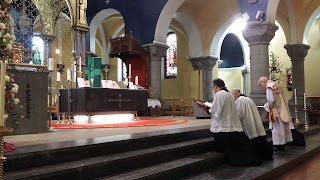


The Cathedral was designed by English architect George Goldie (1828-1887), who was also responsible for the design of Churches in Bohola (1859), Ballymote (1859), Strokestown (1860), Gurteen (1866), and Killasser (1868). The Cathedral's design was 1867. Building took place between 1867 and 1875. It was opened on 26th July, 1874, by Paul, Cardinal Cullen and consecrated by Cardinal Cullen on 1st July, 1897.
The design is in a massive Lombard Romanesque, the only 19th Century Irish Cathedral in the Romanesque style. It is in a basilican style with the triforium gallery extended across the transepts. This effect can also be seen, 'though less correctly and with much less effect, in a Gothic context, in Ss. Peter and Paul's, Cork City. The tower reaches a height of 70 meters. The interior is 69 meters wide at the transepts and 19 meters high. The aisles continue under the triforium right through into a fine ambulatory with a corona chapel that is now a baptistery. The High Altar, surmounted by a statue of Mary Immaculate is intact under a brass baldachino. Some of the stained glass is by Lobin of Tours.


Tuesday, 6 October 2015

Monday, 14 September 2015
8th Anniversary of "Summorum Pontificum"

"It is therefore permitted to celebrate the Sacrifice of the Mass following the typical edition of the Roman Missal, which was promulgated by Blessed John XXIII in 1962 and never abrogated, as an extraordinary form of the Church’s Liturgy. The conditions for the use of this Missal laid down by the previous documents Quattuor Abhinc Annos and Ecclesia Dei are now replaced..." Benedict XVI, Summorum Pontificum, 7th July, 2007.
Wednesday, 9 September 2015
National Latin Mass Pilgrimage to Knock 2015
The National Latin Mass Pilgrimage is a special event in Knock. Unique among Latin Mass pilgrimages around the Country, His Grace, the Archbishop of Tuam has designated this pilgrimage under his own authority and appointed a chaplain, Fr. John Loftus of the Diocese of Killala.
The organisation of the National Pilgrimage was undertaken by Our Lady's Catholic Heritage Association in co-ordination with the other Catholic Heritage Associations around the Country but all Latin Mass Communities, Chaplaincies, Associations and groups around the Country are invited to participate each year.
As usual, the main exercises of the pilgrimage took place in the old Parish Church of Knock, whish stood when the apparitions took place. The apparitions are uniquely Eucharistic in that the Blessed Sacrament was present in the form of the Lamb of God with Our Lady, St. Joseph and St. John, during the whole of the apparition. That may be the reason for the silence of the apparition and perhaps the key to it's central message, the importance of silence in the presence of the Blessed Sacrament - very appropriate for the Traditional Latin Mass.
There was a tremendous turn out from all parts of the Country for a Missa Cantata of Our Lady celebrated by Fr. Loftus. In keeping with the exercises of the official pilgrimages to the Shrine, the Missa Cantata was followed by the Stations of the Cross and the pilgrimage concluded with Benediction of the Blessed Sacrament.


Subscribe to:
Posts (Atom)